
Des Moines County Court Records After a Jail Arrest
After a Des Moines County arrest, the jail side and court side are separate records systems. The Des Moines County Sheriff's Office manages custody at the Des Moines County Correctional Center. The Des Moines County Attorney reviews reports and prosecutes state criminal misdemeanors and felonies that occurred in the county. Once a complaint, trial information, or indictment is filed, the court record tracks the case through the clerk and Iowa Courts Online.
That distinction matters because a booking entry is not the same thing as a filed criminal case. Jail inmate records may help with custody, booking, release, or local hold questions. Jail mugshots are a separate booking-photo issue. Court records after a jail arrest are the source for filed charges, court events, hearing dates, dispositions, fines, costs, and public docket entries after the case is entered.
For local court access, the county courts page points users to the Iowa Judicial Branch for the most complete court information. The Des Moines County courts page lists the Clerk of Court at 513 North Main Street, P.O. Box 158, Burlington, IA 52601, with phone 319-753-8262. The county is in Judicial District 8, and public case data is searched through the statewide Iowa Courts Online system.
The official Des Moines County courts page is useful for the local clerk address, phone numbers, courthouse security notes, and court routing.
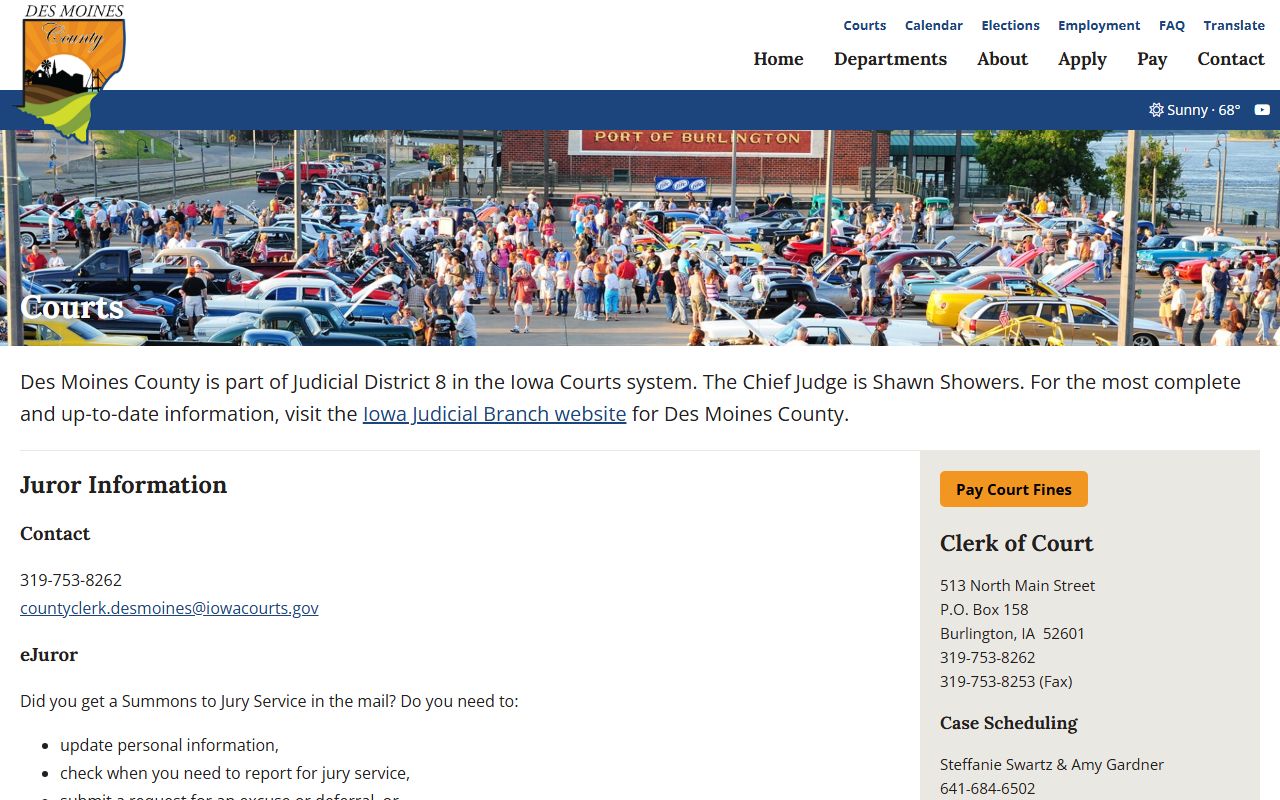
The local court page helps identify the filing county and clerk contact, while Iowa Courts Online is the search tool for public electronic docket entries.
How to Find Des Moines County Court Records After an Arrest
Iowa Courts Online provides free public access to the electronic docket index for Iowa state courts. It is not the official court record itself, and errors should be reported to the district court clerk. Public docket access does not require a paid subscription, although some advanced tools and bond-related search features are described as subscription content. If an arrest just happened, the case may not appear immediately; Iowa Courts Online help material says cases take one business day to appear after entry into the case-management system.
- Open Iowa Courts Online and use the public search portal for trial court case information.
- Search by the defendant's full legal name or by case number if one is already known. Use the arrest report, police log, or booking paperwork to avoid nicknames.
- Narrow by Des Moines County when the interface offers a county filter, then compare case type, filing date, party name, and charge description.
- Open the matching case and review the criminal charges, count numbers, filing events, hearing entries, and disposition fields.
- For public documents that are not downloadable online, use a courthouse public access terminal or contact the Des Moines County Clerk of Court.
Iowa Courts Online is the statewide portal for docket lookups after a Des Moines County arrest has become a filed criminal case.
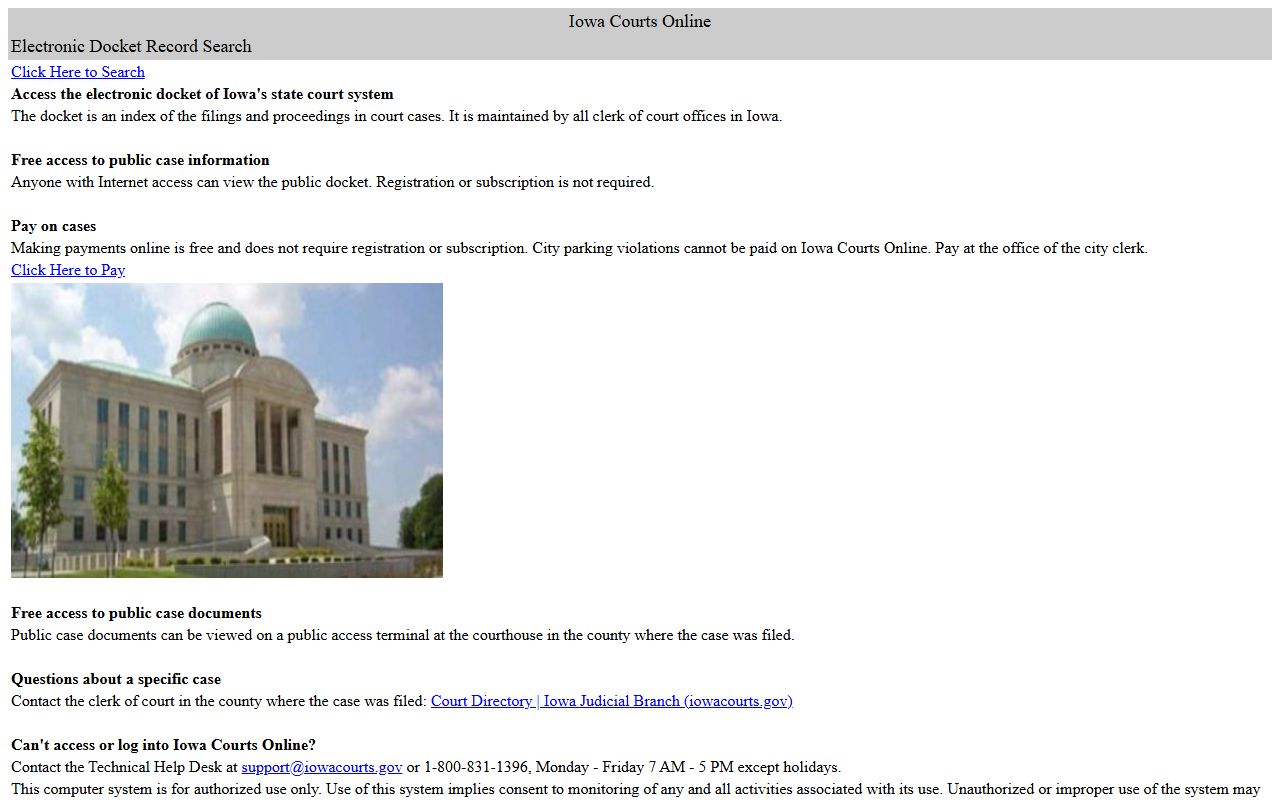
The search portal is best used as a court index. It can identify filed charges and case activity, but current custody should still be checked with the jail, DOC, or VINE system as appropriate.
| Search Field | How to Use It | Local Caution |
|---|---|---|
| Defendant name | Search full first and last name when possible. | People with similar names require date, case type, and filing-date checks. |
| Case number | Use the exact case ID from court paperwork or a docket notice. | A police incident number is not the same as a court case number. |
| County | Select Des Moines County for local trial court matters when available. | Some statewide searches may return cases from other Iowa counties. |
| Date of birth | Use only when the exact date is known and names are entered without wildcards. | Do not guess a date of birth for identity matching. |
| Case type or filing date | Use criminal case type and filing timing to connect the case to the arrest. | Recent arrests may need one business day after court entry before appearing. |
How Charges Get Filed After an Arrest: Complaint, Information, and Indictment
The arrest begins the custody sequence, but the formal court record begins with a charging document or court filing. In Des Moines County, the County Attorney's Office prosecutes state criminal misdemeanors and felonies and enforces county ordinances and state laws that apply locally. The office does not investigate crimes for private persons, give private legal advice, or defend private lawsuits; law enforcement investigates, and the prosecutor decides what to file in court.
| Document | Filed By | Common Use | What It Does |
|---|---|---|---|
| Complaint | Officer or prosecutor | Often used at the start of a criminal case, including misdemeanor matters | States the accusation and supports the court's initial case activity. |
| Trial information | Prosecutor | Common Iowa felony charging document after prosecutor review | Identifies filed charges for prosecution in district court. |
| Indictment | Grand jury | Serious felony or grand-jury matters when used | Charges the defendant through grand-jury action. |
The Des Moines County Attorney page identifies the office as the local prosecutor for state criminal misdemeanors and felonies in the county.
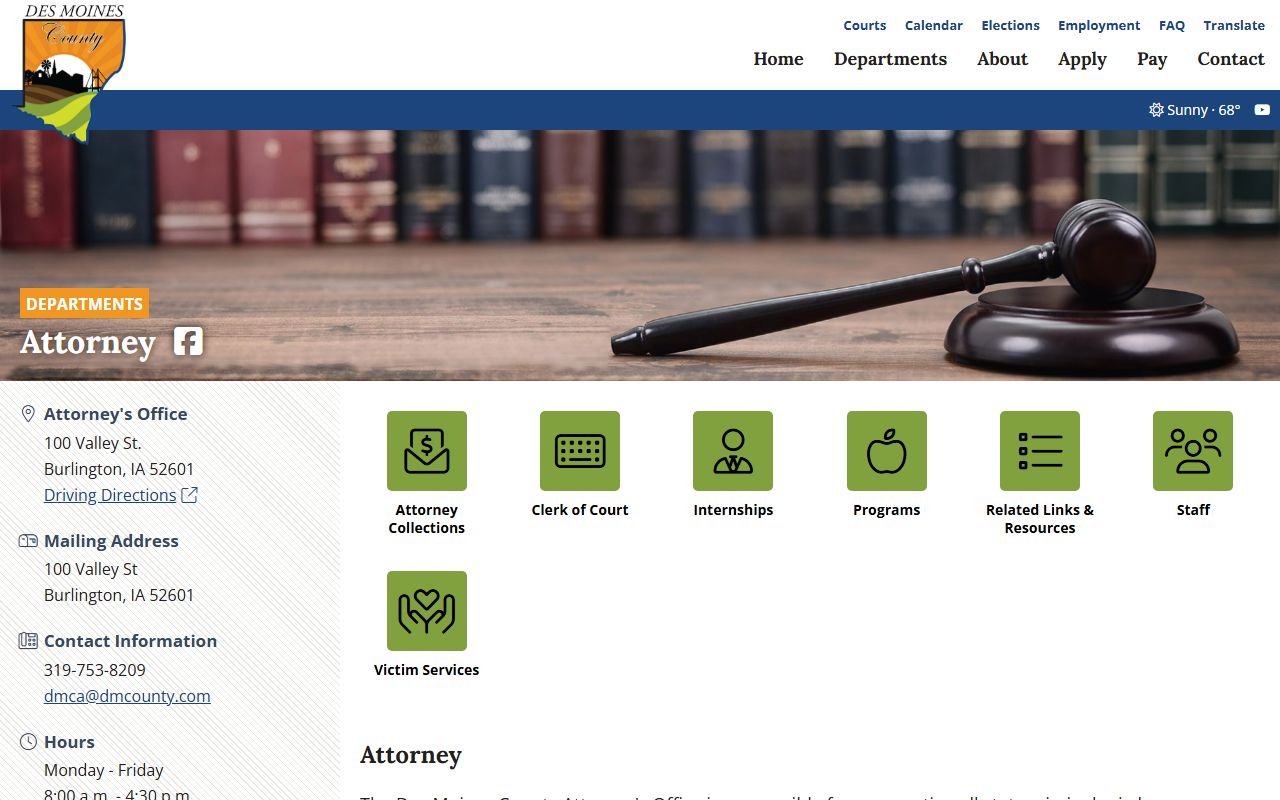
The prosecutor page is important context for court records after a jail arrest because it explains why filed court charges may differ from the initial arrest entry.
Charge Status and What It Means
Booking charges, police log offenses, and court charges can diverge. A Burlington Police Daily Arrest Log may list an offense and Iowa statute tied to the arrest summary. A sheriff or jail booking record may list intake charges. After review, the Des Moines County Attorney may file different charges, add charges, reduce charges, amend language, or dismiss a count. For the filed court record, Iowa Courts Online and the clerk are better sources than a static arrest log.
| Status | What It Means | Why It Matters After Arrest |
|---|---|---|
| Pending | The charge is open and unresolved. | The case has not reached a final disposition on that count. |
| Filed | The prosecutor or court has entered the charge in the case. | This is the formal court charge, separate from the booking allegation. |
| Amended | The charge or charge language changed after filing. | The current court docket may no longer match the first arrest entry. |
| Reduced | The charge was lowered to a less serious offense. | The final prosecuted charge may be narrower than the original allegation. |
| Dismissed | The charge ended without a conviction on that count. | A dismissal is not the same as a conviction, though the docket may still show the history. |
| Acquitted | The defendant was found not guilty. | The case ended in the defendant's favor on that charge. |
| Guilty plea or verdict | A conviction was entered by plea or trial result. | The charge has a conviction outcome unless later changed by court order. |
| Deferred judgment | An Iowa disposition that may avoid a conviction if conditions are met. | Eligibility and effect depend on the statute, order, and case facts. |
Bond and Release After an Arrest
Iowa Code chapter 811 controls bail and release conditions. Section 811.1 generally treats defendants as bailable before and after conviction by sufficient surety, condition, or own recognizance, subject to exceptions. Section 811.2 favors personal recognizance or an unsecured appearance bond unless a magistrate determines those terms will not reasonably assure appearance or will jeopardize public safety. Conditions may address travel, residence, association, supervision, no-contact provisions, a cash deposit, surety, or cash bail.
After a Des Moines County arrest, the local route is practical: call the Des Moines County Correctional Center at 319-753-8275 for current custody questions, check Iowa Courts Online after the case appears, and contact the Clerk of Court at 319-753-8262 for court-case questions. The sheriff jail page links a bonding-agency PDF dated March 13, 2012, so availability should be verified before relying on a listed company. A hold or detainer can prevent release even if a local bond is posted.
| Bond Type | How It Works |
|---|---|
| Cash Bond | Money is deposited under the court's terms. Confirm the amount, payment location, and eligibility with the court or jail before acting. |
| Surety Bond | A bonding company may post bond for an eligible defendant, subject to court terms and the company's current authorization. |
| Personal Recognizance | The defendant is released on a promise to appear, sometimes with nonfinancial conditions. |
| Unsecured Appearance Bond | No cash is deposited up front, but failure to appear can create financial and criminal consequences. |
| No-Bond Hold | Release is blocked by a court order, another agency hold, detainer, or supervision issue until resolved. |
Warrants That Lead to an Arrest
No official Des Moines County public active-warrant search page or warrant list was located in the county or sheriff pages reviewed. The sheriff's office executes and returns legal and civil papers, but the visible sheriff navigation does not provide a public warrant lookup. Warrant questions should be routed to the sheriff, the court clerk, or legal counsel, not nonofficial warrant sites.
Search Iowa Courts Online for criminal cases, missed hearings, and public docket entries that may explain a bench warrant or warrant-related case action. For sheriff records or civil/clerical questions, call 319-753-8212 or use so-clerical@dmcounty.com. If a public warrant record is available from a court or sheriff source, it may show a name, case or warrant number, issuing court, underlying charge, bond amount or no-bond status, issue date, and status. A Burlington Police arrest log may show that an arrest occurred, but it is not an active-warrant list.
Charges vs. Convictions
An arrest and a charge are accusations, not proof that a person committed the offense. Court records after a jail arrest should be read by stage. A charge can be pending, dismissed, amended, reduced, or resolved by plea or trial. A conviction usually requires a guilty plea, guilty verdict, or other conviction-producing disposition entered by the court.
| Charge | Conviction | |
|---|---|---|
| Stage | Accusation filed or pending in court | Final outcome by plea, verdict, or qualifying disposition |
| Proof Standard | Supported by probable cause or charging authority | Requires proof beyond a reasonable doubt or a valid guilty plea |
| Where It Appears | Criminal charges section of the docket | Disposition, judgment, sentencing, and financial entries |
| Effect | May change or disappear as the case moves | Can affect sentencing, court debt, supervision, and criminal-history reporting |
Sealed vs. Expunged Arrest Records
Iowa public access rules do not mean every court or law-enforcement record is always visible online. Iowa Code chapter 22 gives public-record access unless another law applies, but confidential case information, juvenile matters, sealed entries, and protected investigative details can be withheld. If a person believes a Des Moines County arrest or court record should be sealed, expunged, corrected, or restricted, the route is through the court, clerk, or legal counsel.
| Sealed | Expunged | |
|---|---|---|
| Visibility | Hidden from ordinary public access by court order or law. | Removed or treated according to the specific expungement statute and order. |
| Record Holder | The court or agency may still retain restricted access. | Retention, destruction, or limited access depends on Iowa law and the order. |
| Eligibility | Depends on case type, disposition, timing, and court order. | Depends on statutory eligibility and successful court process. |
| Practical Step | Ask the clerk or attorney about the specific case record. | Use court process rather than informal website removal requests. |
Background Check Considerations
Public court lookups and casual docket searches are not the same as legally compliant background checks. Employers, landlords, insurers, lenders, and other decision makers may be subject to the Fair Credit Reporting Act, Iowa law, and other screening rules. A court docket can also be incomplete without courthouse documents, clerk confirmation, and final disposition review.
Important: Des Moines County Inmate Population is not a consumer reporting agency, and record information may not be used for FCRA-covered decisions.
Restricted Court Records After an Arrest in Des Moines County
Iowa Courts Online excludes juvenile and other confidential case information from public online access. The help material also says free public docket information can include basic case titles and filings, party and lawyer names, criminal charges, disposition entries, child support payments, fines and fees owed, and payment details, but public documents may need to be viewed at courthouse terminals in the county where the case was filed. Iowa Code section 22.7(5) protects peace officers' investigative reports, while section 22.7(9) treats criminal identification files as confidential but identifies current and prior arrests and criminal history data as public records.
Public access is therefore specific to the record type. A filed court charge may be public while a police investigative narrative, juvenile detail, sealed filing, medical information, victim-sensitive material, or nonpublic pretrial information is withheld. For Des Moines County court records after a jail arrest, use Iowa Courts Online for the docket, the clerk for official court files and corrections, and the sheriff records process for law-enforcement records that are not court-held.